If you've sourced lifting slings for export cargo, steel pipe bundles, or long-distance shipments, you've probably come across the term one trip textile sling. It's often mistaken for a lower-quality version of a standard webbing sling — but that's the wrong way to think about it.
A one trip sling isn't a cheaper substitute; it's a purpose-built product engineered around a single, specific job: accompanying one load, one time, from origin to final destination. Understanding what actually defines this product — and where it can and can't be used — matters whether you're a manufacturer specifying materials, an exporter selecting rigging for a shipment, or a buyer trying to figure out why your supplier keeps insisting you can't reuse it.
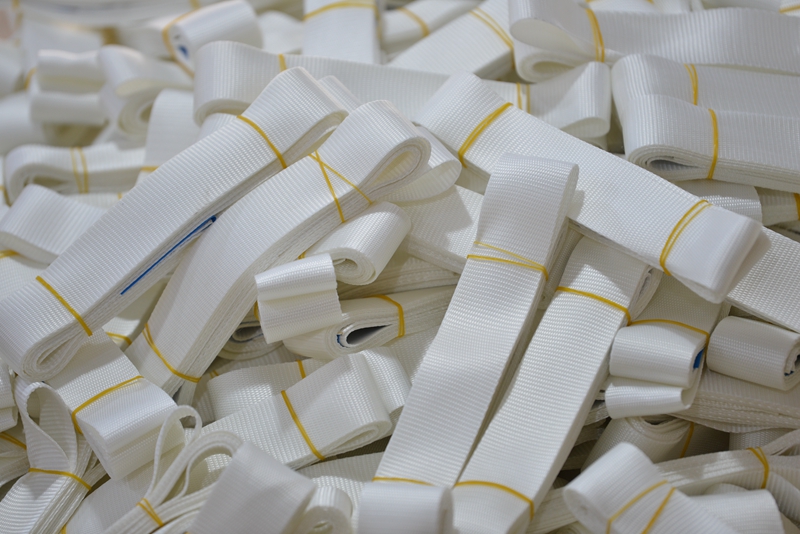
A one trip textile sling is a woven textile sling designed for the specific purpose of attaching to, and accompanying, a specific load for its specified journey — from source to final destination. Once that journey is complete, the sling's job is done.
The defining rule isn't the material or the weave pattern; it's the intended use. These slings must not be used as general-purpose lifting slings, and they must not be used outside the limitations of use specified by the manufacturer or for numerous loads across multiple lifts.
When the journey ends, the sling is taken out of service and destroyed to prevent any further use.
This single-use design shows up constantly in real-world export operations — steel and pipe mills bundling tube or bar stock for overseas shipment, timber and structural panel exporters, and machinery manufacturers securing equipment for container loading. In each case, the sling travels with the cargo through intermediate loading and unloading points until the final drop, at which point the supplier's liability for the sling ends and it's discarded.
This is where one trip slings diverge most clearly from standard industrial slings, and where a lot of confusion comes from. The justification for a one trip sling's design is low utilization — the sling only ever sees one load cycle, so its safety factor doesn't need to match a sling that will be loaded and unloaded thousands of times over its service life.
Several current standards support this lower safety factor, provided the manufacturer has documented it correctly:
Compare that to a standard reusable industrial webbing sling, which is typically rated at a 5:1 factor as well, but is engineered and tested to survive that ratio across a full working life of repeated lifts, not a single one. The number "5:1" can look identical on paper, but the service assumption behind it is completely different — which is exactly why a one trip sling can't simply be relabeled and reused as a standard sling, even if it technically survived one lift undamaged.
One trip slings sit in an interesting regulatory position. Standards like DIN 60005 are useful and widely referenced, but they are not EU/UK harmonized or approved standards — meaning they don't automatically carry a presumption of conformity to the Machinery Directive / Supply of Machinery (Safety) Regulations (MD/SOM(S)R).
In practice, this means:
LEEA (the Lifting Equipment Engineers Association) goes a step further on labelling, recommending that the sling's label and/or body carry a clear warning such as "One trip – Do not reuse" or an equivalent phrase. Where the end user's location and language are known, this warning is required to be written in the officially recognized language of that location — not just English. For an export business shipping into multiple markets, that's a detail worth building into your labelling process by default rather than adding case by case.
In practice, one trip textile slings show up heavily in industries where cargo moves once, through a defined chain of custody, and doesn't come back:
| Industry | Typical Application |
|---|---|
| Steel & pipe export | Bundling pipe, tube, or bar stock for overseas shipment |
| Timber & construction | Securing long timber, roof trusses, or prefabricated panels for transport |
| Machinery & equipment | Lifting equipment into export containers |
| Oil & gas | Handling hoses, valves, or piping en route to offshore rigs |
| Marine & dry dock | Lifting boats or barges out of water for repair or relocation |
Exporters favor these slings for a practical reason beyond cost: they eliminate the retrieval problem. A reusable sling shipped with cargo to an overseas buyer either has to be sent back at the exporter's expense or gets absorbed as a loss. A one trip sling is priced and engineered around being used once and discarded at the final destination, which simplifies the whole transaction for both sides.
A one trip textile sling should never be selected purely on price as a substitute for a standard reusable sling, and it should never be kept in service or reused after its designated journey — doing either undermines the entire safety logic the product is built on. If you're manufacturing or exporting these slings, get the marking, the DoC scope, and the language requirements right from the start; if you're buying them, treat the "one trip – do not reuse" label as a hard rule, not a suggestion.
If your team is sourcing one trip textile slings for export packaging or evaluating whether your current supplier's documentation actually meets MD/SOM(S)R and DIN 60005 requirements, we're happy to walk through the specifications, safety factors, and marking details for your specific cargo and destination markets.