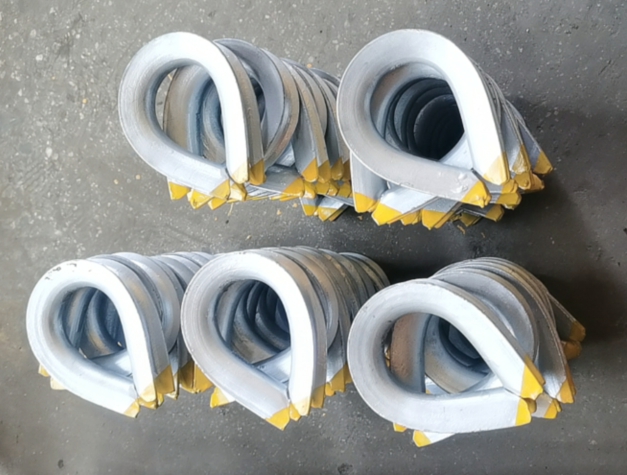
You rely on wire rope for lifting, pulling, securing, and countless critical tasks. It's strong, durable, and essential. But where the rope forms a crucial loop – an eye or an end termination – it faces a hidden enemy: abrasion and crushing forces. That's where a seemingly simple yet indispensable component comes in: the wire rope thimble.
Think of a thimble as the armored guard protecting the heart of your wire rope termination.
Defining the Thimble:
A wire rope thimble is a grooved, typically U-shaped or circular metal insert placed inside the eye of a wire rope sling, grommet, or loop termination. Its primary job is to:
Protect the Wire Rope: It shields the rope from direct wear and tear where it contacts shackles, hooks, pins, or other hardware.
Maintain the Eye Shape: It provides a rigid form that helps the rope eye retain its proper shape and size under load, preventing deformation and pinching.
Distribute Load: By providing a smooth, hard surface, it helps distribute the load more evenly around the circumference of the eye, reducing stress concentrations on individual wires.
Reduce Friction & Abrasion: The smooth groove minimizes friction between the rope and the connecting hardware, significantly reducing internal and external abrasion that weakens the rope over time.
Why is a Thimble So Important? Skipping it is a critical mistake.
Without a thimble:
Accelerated Wear: The rope rubs directly against hard metal surfaces (like a shackle pin), causing rapid strand and wire breakage.
Deformation & Pinching: The eye can collapse or flatten under load, kinking the rope and severely reducing its strength.
Reduced Strength: Abraded and deformed rope at the termination point drastically lowers the overall breaking strength of the assembly.
Safety Hazard: A weakened or damaged eye is a prime point for catastrophic failure during a lift or pull, endangering personnel and equipment.
Shorter Rope Life: The rope will need replacement much sooner due to localized damage at the termination.
Anatomy of a Thimble:
Groove: The curved channel where the wire rope sits. Its diameter matches the rope size precisely.
Crown: The rounded outer surface that bears against the connecting hardware (shackle, hook, etc.).
Legs/Arms: The sides extending down from the crown. In a "fold-over" or "heart" thimble, these may be designed to be folded around the rope after insertion.
Material: Most commonly made from carbon steel or stainless steel, chosen for strength, durability, and corrosion resistance depending on the application. Galvanized steel is common for outdoor use.
Types: The most common is the U-shaped grooved thimble. Others include fold-over thimbles (where legs wrap around the rope) and pocket-type thimbles for specific applications.
Where Are Wire Rope Thimbles Used?
Anywhere a wire rope forms a loop that connects to hardware:
Sling Eyes: On the ends of wire rope slings.
Grommets: Inside continuous wire rope loops.
End Terminations: When creating eyes using swaged or poured sockets, mechanical fittings, or even hand-spliced eyes (though thimbles are less common with high-efficiency terminations like sockets).
Lifting Applications: Cranes, hoists, winches.
Rigging: Securing loads, towing.
Marine: Mooring lines, sailboat rigging.
Construction: Guy wires, safety lines.
Agriculture & Industry: Towing, pulling, securing equipment.
Choosing and Using Thimbles Correctly:
Match the Size: This is absolutely critical. The thimble groove size MUST match the nominal diameter of the wire rope. Using an undersized thimble crushes the rope; an oversized one allows movement and slippage, defeating its purpose. Always refer to manufacturer specifications.
Proper Installation: The thimble must be fully and securely seated within the rope eye. The rope should fit snugly into the groove along its entire circumference. For hand-spliced eyes, the splice must be correctly formed around the thimble.
Inspection: Regularly inspect thimbles as part of your overall wire rope and rigging inspection program. Look for:
Excessive wear in the groove or on the crown.
Cracks, bends, or distortion.
Severe corrosion (especially pitting).
Evidence of the rope having jumped out of the groove.
Replacement: Replace any thimble showing significant wear, damage, or deformation. A damaged thimble can quickly destroy your wire rope.
The Bottom Line:
A wire rope thimble is a small, relatively inexpensive component that plays a massive role in safety, efficiency, and cost-effectiveness. It protects your valuable wire rope investment at its most vulnerable point, ensures the integrity of the termination, and significantly extends the service life of your rigging assemblies. Never underestimate its importance – always use the correctly sized, high-quality thimble for every wire rope eye termination.
Protect your lifts, protect your people, protect your investment. Always use a wire rope thimble.