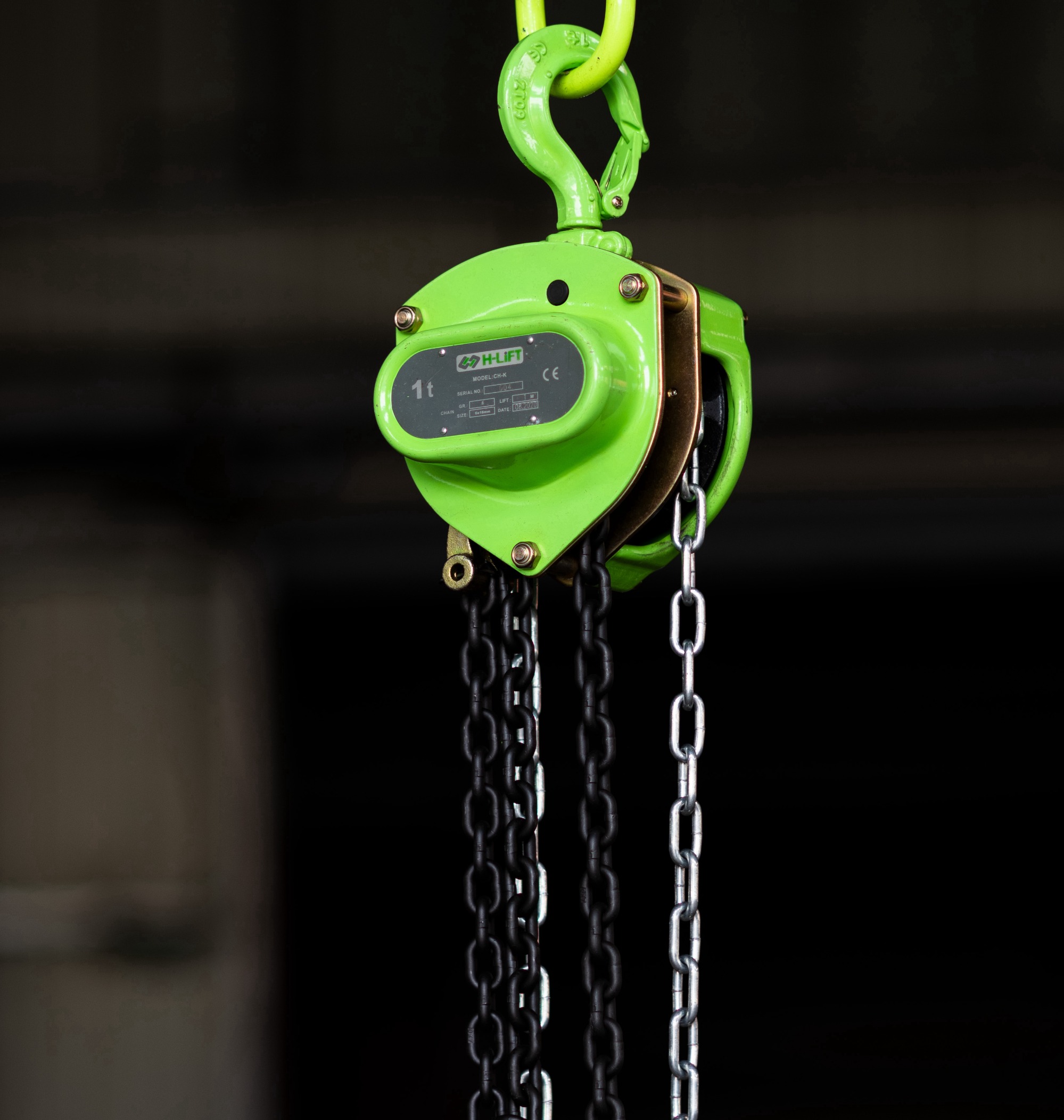
Manual hoisting equipment refers to lifting devices that are operated by human power (manual effort) rather than by electric, hydraulic, or pneumatic systems. These tools are commonly used in construction, manufacturing, warehousing, and maintenance tasks where precise load handling is required without the need for motorized power.
Types of Manual Hoisting Equipment
Chain Hoists (Chain Blocks)
- Uses a hand-operated chain to lift or lower a load.
- Common in workshops and construction.
- Load capacity typically ranges from 0.5 tons to 20 tons.
Lever Hoists (Come-Alongs)
- Operated by a hand lever to pull or lift loads.
- Often used for rigging, towing, and positioning heavy objects.
- Usually has a lower capacity (1-5 tons) compared to chain hoists.
Wire Rope Hoists (Manual Winches)
- Uses a hand-cranked mechanism to wind a wire rope.
- Suitable for pulling or lifting in marine, agriculture, and industrial settings.
Block and Tackle Systems
- Consists of pulleys (sheaves) and a rope to multiply lifting force.
- Used in sailing, construction, and rescue operations.
Advantages of Manual Hoisting Equipment
✔ No need for electricity or fuel.
✔ Portable and easy to use in remote locations.
✔ Lower maintenance compared to powered hoists.
✔ Cost-effective for light to medium-duty lifting.
Disadvantages
❌ Limited to lower lifting speeds.
❌ Requires physical effort, which can be tiring.
❌ Not suitable for very heavy loads (unlike electric or hydraulic hoists).
Common Applications
- Loading/unloading materials in warehouses.
- Machinery maintenance and repair.
- Construction and rigging operations.
- Emergency recovery and vehicle pulling.
H-Lift supplies such manual hoisting equipments as manual chain hoist, lever hoist, push and geared trolley, beam clamp,beam clamp with shackle, lifting clamp,wire rope pulling hoist, lifting magnets,snatch block,crane scale, etc.